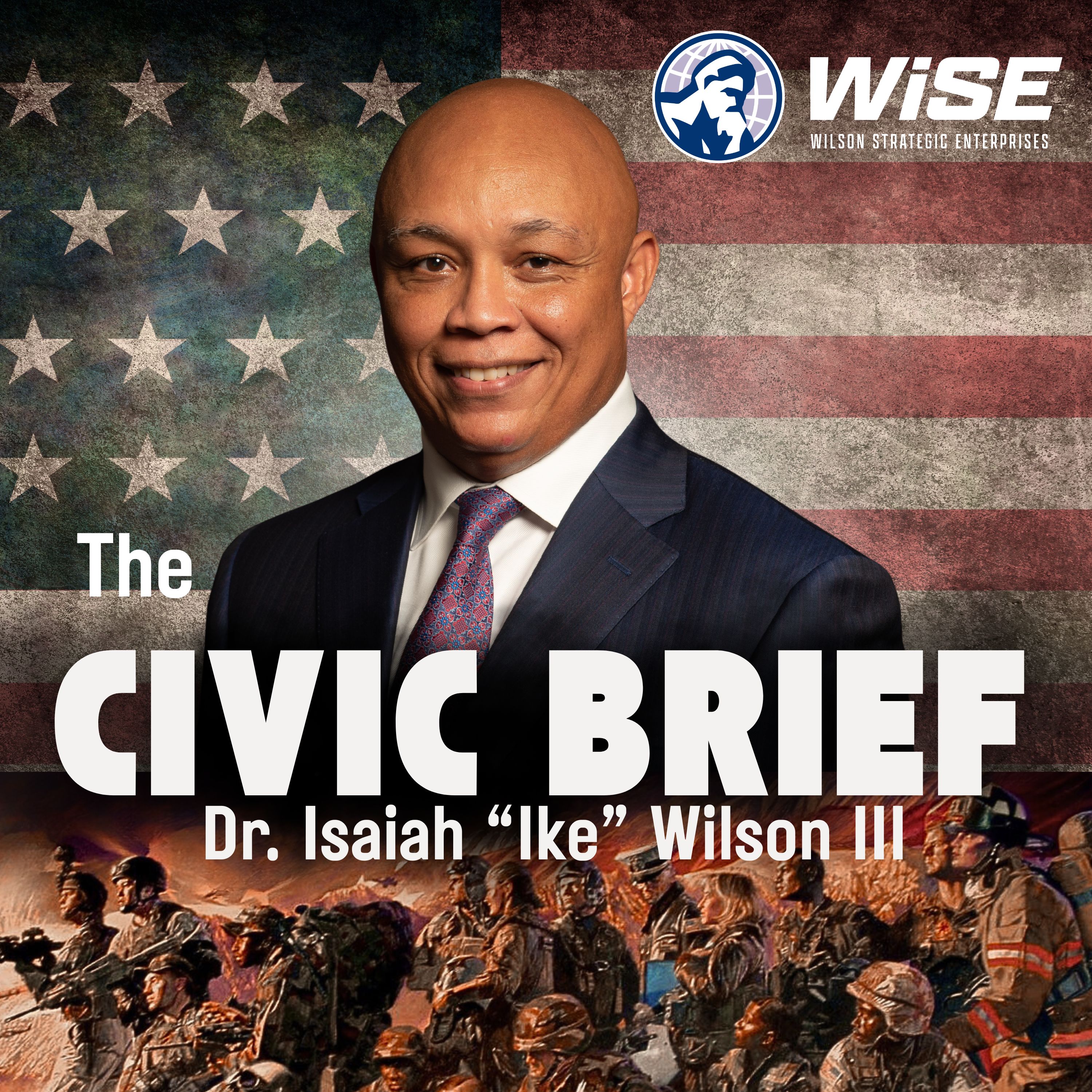
Scandology: Governance by Exhaustion
There are moments in a republic’s life when danger does not arrive with tanks or decrees. It arrives through normalization and exhaustion.
In this solo episode of The Civic Brief, Dr. Isaiah “Ike” Wilson III introduces a concept he calls Scandology — the use of permanent scandal as a governing system. In Scandology, exposure replaces enforcement, outrage substitutes for accountability, and democratic institutions appear busy while fundamental power arrangements remain unchanged.
Rather than analyzing individual controversies in isolation — immigration, policing, elections, federal enforcement — Dr. Wilson reframes the moment as one of compound civic risk, where multiple systems interact simultaneously, amplifying strain on legitimacy.
This episode also introduces the second installment of “The WiSE Way: Civics 101 Brief” segment, exploring the foundational constitutional distinction between civil liberties and civil rights — and why confusion between the two weakens democratic resilience.
The central warning:
Democracy rarely collapses in a single blow. It erodes through adjustment, accommodation, and exhaustion.
What You’ll Learn in This Episode:
✅ What “Scandology” means — and how permanent scandal can stabilize power rather than threaten it.
✅ How compound risk environments blur immigration, policing, race, identity, and foreign policy into one legitimacy crisis.
✅ Why normalization — not chaos — is the greater democratic danger.
✅ The critical constitutional difference between civil liberties and civil rights — and how that distinction is being redefined under strain.
Join the Travelers Community and explore resources at Wilson WiSE Consulting, as well as at Dr. Wilson’s companion Substack Newsletter, “Compound Security, Unlocked,” where you can share insights, ask questions, and help shape the future—one brief at a time.
- Wilson WiSE Consulting Website: https://wilsonwise.com/
- Substack: https://compoundsecurityunlocked.substack.com/
Key Timestamps:
00:00 Introduction: When danger arrives as normalization
01:07 Defining “Scandology”: Permanent scandal as governance
02:18 Compound risk: Why no issue stands alone
03:00 Phase Zero logic applied domestically
04:23 Accountability lag and coercive advantage
05:45 Brittleness vs. resilience in democratic systems
06:29 Governance by exhaustion
07:13 WiSE Way: Civics 101 – Civil rights vs. civil liberties
12:59 When security logic overrides constitutional logic
Key Takeaways:
💎 Permanent scandal can become a governing system. When outrage replaces enforcement and exposure substitutes for resolution, power adapts rather than reforms.
💎 Compound risks amplify legitimacy strain. Immigration, policing, race, elections, and national identity are interacting systems — not isolated controversies.
💎 Normalization is preparation. Repeated rhetorical framing conditions public acceptance long before formal action is taken.
💎 Civic literacy is democratic self-defense. Understanding the difference between civil liberties (limits on government) and civil rights (guarantees by government) is essential to protecting constitutional balance.
Resources & Mentions:
- Apple Podcast- The Civic Brief
- Spotify - The Civic Brief
- YouTube- The Civic Brief
- Wilson WiSE Consulting Website: https://wilsonwise.com/
- Connect with Dr. Wilson on LinkedIn: https://www.linkedin.com/in/dr-ike-wilson/
- Think Beyond War: https://thinkbeyondwar.com/
- Subscribe to the Substack Community to join the discussion, share your insights, and help defend the guardrails of democracy: https://compoundsecurityunlocked.substack.com/
Related Civic Brief Essays:
- Scandology and the Childcare Funding Freeze
- Scandology in the Compound Republic
- The SOTU as Stagecraft, and the Republic as Prop
- Scandal as Governance
- Beyond “Conflicts to Watch"
- ‘Notes On A Scandal’ In Minneapolis
- ESSAY I: Manifest Destiny 2.0 at Home
- ESSAY III: A Republic Recast
- When the Front Line Is Everywhere
SEO Keywords:
Civic Engagement Podcast, National Security and Public Policy, Leadership and Strategy Podcast, Dr. Ike Wilson Podcast, The Civic Brief, Governance by exhaustion, Legitimacy vs. spectacle, Phase Zero political preparation, Terrorism as psychological framing, Brittleness vs. resilience in democratic systems, Constitutional balance and equipoise, Liberty, order, and restraint
Transcript
[00:00:18] There are moments in a republic's life when danger does not announce itself as danger. It does not arrive with tanks, it does not arrive with decree. It arrives as normalization. A speech here, a threat there, an executive order framed as necessity, A raid described as enforcement. Each action taken alone can be argued over, explained away, litigated in good faith, but history rarely moves one action at a time.
[:[00:01:07] So we have a language problem today. We keep calling what we're experiencing, scandal as if exposure alone were corrective, as if outrage automatically produce accountability, as if attention were the same thing as consequence. Well, it's not what we're living under now is something different. I call it Scandology.
[:[00:01:54] It's because systems under legitimacy, strain, well, they adapt. When formal [00:02:00] accountability becomes too slow, too politically costly or too destabilizing. Scandal becomes the pressure valve outrage. It becomes vented power, though remains. Now. One reason this moment feels disorienting is that we keep trying to understand it one issue at a time.
[:[00:02:41] This is what compound risks looks like. Multiple systems interacting simultaneously. Amplifying one another's effects. Now, when governance failures occur under compound conditions, they don't stay contained. Just like the word says, they compound. In military planning, there's a phase that [00:03:00] matters more than the battle itself.
[:[00:03:22] Public musings about delayed and delaying elections. Casual references to domestic enemies. Each statement is often defended as rhetoric, exaggeration or bluster, but ambiguity itself becomes the weapon. It forces the public to imagine the unthinkable and once imagined. Well, it becomes thinkable Minneapolis.
[:[00:04:02] When an ice officer killed a civilian during an operation, the system responded instantly. Terrorism was invoked. Force was justified. Investigations. They were promised, but notice the order. The label came first. The force then followed accountability. It was deferred. This is phase zero logic applied domestically.
[:[00:04:45] Courts trail executive action, public understanding. Therefore, trails implementation, this lag is not neutral and coercive systems lag always favors force. By the time accountability mechanisms engage, catch up and engage, [00:05:00] if frankly they do it all. Harm has already occurred, the illegality has already taken place.
[:[00:05:26] Communities adjust before policy even arrives. Fear. It becomes governance and advanced. This is preparation without deployment enforcement by shadow. This is efficient, and folks, it's also corrosive. Now, from the outside, this posture looks strong. It might look strong. Decisive, even unapologetic visible.
[:[00:06:04] Now, one reason these dynamics persist is scandal saturation. Each controversy displaces the last each outrage. Competes for attention. The public, well, they become reactive, not strategic. This is Scandology in full effect. When everything is urgent, well, nothing is decisive. The question before us is not whether Donald Trump will invoke the insurrection Act or whether elections will be delayed.
[:[00:06:48] It has to begin earlier before that normalization performs and becomes permanence. This has been the civic brief, my solo spot. Please stay engaged, stay alert, and let's [00:07:00] not confuse exhaustion with consent. Now, travelers. Last, uh, month, last episode, we tried an experiment with a new spot, a new short spot that I, um, am going to try to add into my solo spots going forward.
[:[00:07:38] Or we were taught more myth than reality. So we're gonna, we're gonna do this as our second experiment with this, and I'm looking for your feedback, uh, to let me know if these types of civics 1 0 1 in brief segments, uh, added to these episodes. Are helpful or not. Um, and we'll move on from there. But I'm doing this basically from feedback from you, the [00:08:00] listeners, from our travelers community.
[:[00:08:27] Lack of knowledge on a fundamental of our constitutional self called civil rights and civil liberties. So civil rights, civil liberties. What are they, uh, why the difference matters, and how is it being compromised today, particularly through this, this, uh, dynamic of scandal? Before we can understand what's being lost, we have to understand what we are given and given constitutionally.
[:[00:09:16] Democracy at large. Well, it weakens civil liberties. Civil liberties are protections from government power. They are the thou shal not nots of the Constitution. Right? Government shall not restrict your speech. Government shall not search your home without cause. Government shall not detain you without due process.
[:[00:10:05] Here's the, you know, the founders and the framers were great. They were brilliant, but they were also human, right? So Bill of Rights is an articulation of government's role to restrict itself on behalf of giving free space and a free market pace, place of competing ideas for us to have as individuals, as much liberty and freedom as possible, right up to the point, and not to cross over that point where our exercise of liberty and freedom encroaches on the liberty and rights of the person to our left and right.
[:[00:10:56] They are guarantees by the government. This is ProAct action on the [00:11:00] part of, of the government, equal protection under the law. We're all familiar with that. Equal access to public institutions protection from discrimination based on race, religion, sex, or national origin. We're all familiar with those things.
[:[00:11:39] Healthy democracies depend on the balance between these two. Liberties, restraining power, rights, disciplining its use. Now when liberties are protected, but rights are ignored, inequality flourishes. But when rights are declared, but liberties are suspended, authoritarianism then follows the Constitution.
[:[00:12:23] This is what we're talking about here in the implementation structure of the balance point between government's role in ensuring as much civil liberty as we can attain as individuals and communities. But having that government still being there as a referee, if you will, to make sure that our exercise, our full exercise of liberty, does not encroach on the rights or deny the rights of others.
[:[00:13:17] The state doesn't say you no longer have rights. It does say under these conditions, those rights must wait. That is how erosion happens folks. The role of government and democracy is not to choose between liberty and order. Lemme say that again. The role of government in a democracy is not to choose or force our choosing between liberty and order.
[:[00:14:02] As I hope I've demonstrated in this short segment, they're lived experiences. Just talk to the community and the people in Minneapolis, Minnesota these days when either is compromised, citizens feel it long before courts rule on it. Understanding the difference is not an academic thing. It's civic self defense, because a society that cannot name what it is losing well, that same society will struggle to protect it.
[:[00:14:48] Thanks for tuning into this civic brief. Uh, questions, insights, or ideas. Join us@thecivicbrief.com to continue the dialogue, subscribe, share, and be part of shaping the future one brief at a [00:15:00] time.