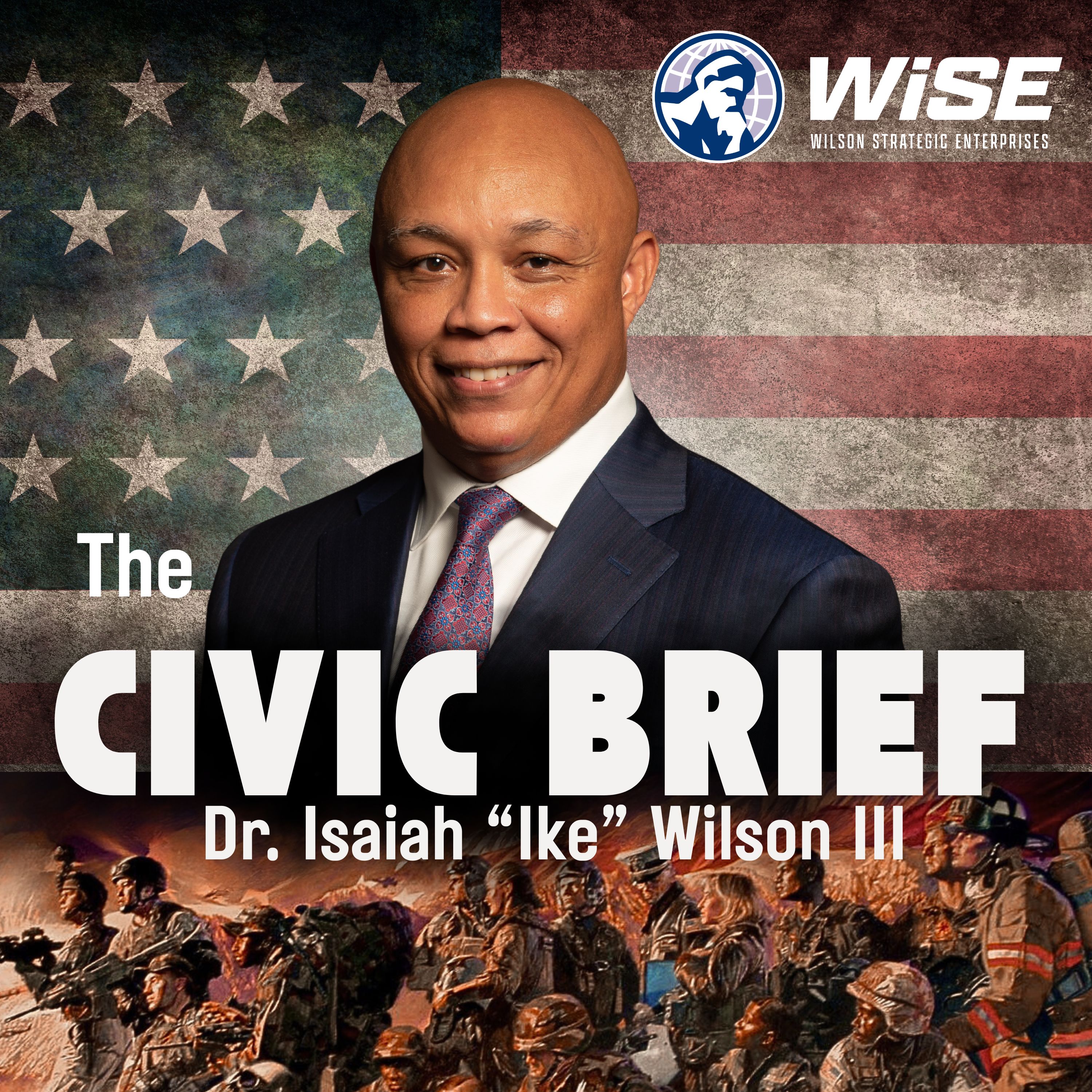
THE WiSE WAY: Force, Faith & Civic Balance
In this ‘THE WiSE WAY’ installment of The Civic Brief, Dr. Isaiah “Ike” Wilson III examines one of the most consequential and misunderstood dynamics shaping America’s future: the collapsing balance between humanitarianism, development, and state power.
Drawing from moral philosophy, national security strategy, and civic theory, Dr. Wilson explains why humanitarian aid alone cannot substitute for development — and why development itself has historically been one of America’s most effective non-military tools of power. As the United States retreats from climate leadership, global development institutions, and long-term foresight, humanitarian systems are buckling, faith institutions are overextended, and force is increasingly deployed where foresight should have prevailed.
Using vivid metaphors — humanitarianism as a tourniquet and development as rehabilitation — Dr. Wilson illustrates how crises become permanent when development collapses. He then maps today’s compound security collisions: climate shocks, migration pressures, humanitarian overload, faith institutions filling governance gaps, and state force misapplied to structural failures.
Dr. Wilson concludes with a forward-looking framework for polycentric partnership and a reimagined civic role for faith communities — not as replacements for the state, but as stabilizers, moral circuit breakers, foresight partners, and civic rebuilders. At its core, this episode challenges listeners with a sobering civic question: What kind of nation do we become when compassion is expected, but strategy is withdrawn?
What You’ll Learn in This Episode:
✅ Why humanitarianism and development are not interchangeable
✅ How America’s retreat from development accelerates global and domestic instability
✅ Why faith institutions are being forced into unsustainable governance roles
✅ How climate shocks, migration, and humanitarian overload collide as compound threats
✅ What “polycentric partnership” means for the future of civic resilience
✅ Why force increasingly fails when foresight is abandoned
Join the Travelers Community and explore resources at Wilson WiSE Consulting, as well as at Dr. Wilson’s companion Substack Newsletter, “Compound Security, Unlocked,” where you can share insights, ask questions, and help shape the future—one brief at a time.
- Wilson WiSE Consulting Website: https://wilsonwise.com/
- Substack: https://compoundsecurityunlocked.substack.com/
Key Timestamps:
00:00 Welcome to the WiSE WAY: Force, Faith & Civic Balance
01:50 The uneasy triangle: humanitarianism, development, state power
03:27 Why humanitarian aid is a tourniquet, not a solution
04:22 America First 3.0 and the dismantling of development power
05:33 Six compound security collisions shaping 2025
07:30 When force fills the void left by development collapse
08:23 The expanding civic role of faith institutions
09:35 Polycentric partnership and the future church
11:00 Why compassion without strategy leads to exhaustion
11:55 Seven civic questions for a republic in transition
Key Takeaways:
💎Humanitarianism saves lives — development prevents crises.
💎When development collapses, humanitarianism becomes permanent and unsustainable.
💎Faith institutions cannot replace functioning state systems indefinitely.
💎Climate insecurity, migration, and governance failure are structurally linked.
💎Force applied without foresight worsens instability rather than resolving it.
💎A mature republic must balance compassion with long-term strategy.
Resources & Mentions:
- Apple Podcast- The Civic Brief
- Spotify - The Civic Brief
- YouTube- The Civic Brief
- Wilson WiSE Consulting Website: https://wilsonwise.com/
- Connect with Ike on LinkedIn: https://www.linkedin.com/in/dr-ike-wilson/
- Think Beyond War: https://thinkbeyondwar.com/
- Subscribe to the Substack Community to join the discussion, share your insights, and help defend the guardrails of democracy: https://compoundsecurityunlocked.substack.com/
Quotes:
“Humanitarianism is the tourniquet — it stops the bleeding. Development is the rehabilitation that prevents the injury from happening again. When we abandon development, the crisis becomes permanent.” - Dr. Isaiah “Ike” Wilson III
“When development collapses, faith institutions are asked to do the work of the government. Compassion fills the gap — but compassion without strategy eventually becomes exhaustion.” - Dr. Isaiah “Ike” Wilson III
“No amount of prayer can replace clean water systems. No amount of volunteerism can replace functioning institutions. Even faith requires infrastructure.” - Dr. Isaiah “Ike” Wilson III
Tags:
Civic Engagement Podcast, National Security and Public Policy, Leadership and Strategy Podcast, Dr. Ike Wilson Podcast, The Civic Brief, THE WiSE WAY, force and faith, humanitarian aid, international development, compound security, climate insecurity, civic resilience, faith institutions, American leadership, polycentric partnership, governance collapse, infrastructure
Transcript
[00:00:21] Dr. Isaiah "Ike" Wilson III: fellow travelers. Welcome back to the Civic Brief and this. Being the wise way segment of our experience, four focused on force faith and the American experience. This wise way, we're gonna apply techniques and tools, um, that can range from, uh, the battlefields to the boardrooms, if you will. Or more importantly perhaps from our neighborhoods to negotiation tables.
[:[00:01:19] Augustine called the city of man and the city of God. What I wanna do today with the wise way is to talk specifically in terms of forced faith and what that means for us today and into the future. So again, welcome here. We take the Moral questions explored in the main episode with our guests, Bishop John Stowe, and then we're gonna walk them into again, that strategic, operational and civic terrain where they actually live in real practical terms.
[:[00:02:13] Now, if the main episode asked about faith communities meeting force on the ground, which it did. Today we're gonna ask what happens when the state completely walks away? What happens when development collapses? What happens when humanitarianism is asked to do the work of government and governance? And what does this mean for America's future, both at home and in the wider world?
[:[00:03:03] Development on the other end of the spectrum speaks to long-term nation and state shaping. It's slow, it's strategic, it's structural, and it's civic. It prevents crises from occurring, and frankly, when done properly in a preventive defense, uh, sort of way, it actually prevents crises from ever manifesting in the first place.
[:[00:03:51] Now, when you remove development, humanitarianism becomes permanent, and when you remove humanitarianism, [00:04:00] crises becomes death. Now for decades, the United States through U-S-A-I-D, the Department of State programs like the Millennium Challenge Corporation. The Overseas Private Investment Corporation and US International Development Finance Corporation, as well as many others, partner institutions across the board, they've understood this.
[:[00:04:48] Its absence accelerates global instability, not because America is needed as a any kind of savior, but because America presence historically helped prevent the creation of [00:05:00] vacuums a vacuum that adversaries now are filling joyfully humanitarianism needs. Are rising development pathways are collapsing.
[:[00:05:33] First, what, what we see today is a perfect example of compound dynamics. First climate shocks that are escalating, human insecurity, famine displacement, resource scarcity. The United States withdrawal from COP 2025, the climate change, um, convention in symposium, signals abandonment. At the very moment, global coordination is most [00:06:00] needed.
[:[00:06:32] That puts added pressures on state and and national public administration systems, making them all the more brittle and ripe for breaking. Fourth, we see faith institutions stepping into that, increasing and broadening breach, sheltering migrants, feeding families, stabilizing neighborhoods. But all too often, too little, too late for not long enough, not strategically, [00:07:00] they're not doing these things strategically.
[:[00:07:30] This is where force and faith collide in a, in a very tragic and deleterious way, in the void left when development ceases to exist at all. And, and friends, fellow travelers. This is our sad, tragic story of 2025. Now, I want to begin to end with some thoughts on foresighting and future roles, uh, for, for particularly for the church in this, in this widening chasm of force and force and faith.
[:[00:08:23] In, in more theological and philosophical, uh, um, context that Augustinian, that St. Augustinian sense of finding that balance echo poise between what is the, the, the city of man, our life on terra firma on planet earth, in this ethereal city of God, right? Imbalances in all things from the individual human to the most grand geopolitical.
[:[00:09:13] In real terms, charity without structural partner in partnership becomes frankly, futility. At an eventual point in time and space. Now, the future, therefore, under these conditions, are gonna, is going to demand what I've talked to you all and talked with you about in, in the past, what I call, you know, this big term called polycentric partnership.
[:[00:09:59] [00:10:00] We're seeing it today already, and we're gonna see more of it, uh, the church holding communities together as storms, literal, unfortunately, and political growing stronger. Secondly, we're gonna see the church as increasingly that moral circuit breaker, deescalating tensions where police or military force is the wrong tool.
[:[00:10:44] And fourthly, we're gonna see an increasing role of the church as what I'll call a civic rebuilder. Not replacing the state, but helping restore the civic intermediaries that make democratic republicanism resilient. But none of this works [00:11:00] if development is abandoned completely and totally. No amount of prayer can replace clean water systems.
[:[00:11:39] I'm gonna give you a seven. I'm gonna give us seven to ponder and maybe we can talk about these as you visit, uh, compound security. Unlock the SUBSTACK newsletter, that companion civic brief, and as we continue our journey together, traveling together through future experiences of the civic, civic brief.
[:[00:12:16] Fourth, what does climate leadership mean? When the world's leading democracy refuses to show up at the conferences, where should force end and where must foresight begin? That's our fifth question. Question six, what happens when humanitarianism becomes permanent? And development becomes, well, frankly, extinct in seventh.
[:[00:13:09] Narrator: Thanks for tuning into the civic brief, uh, questions, insights, or ideas. Join us@thecivicbrief.com to continue the dialogue, subscribe, share, and be part of shaping the future one brief at a time.